
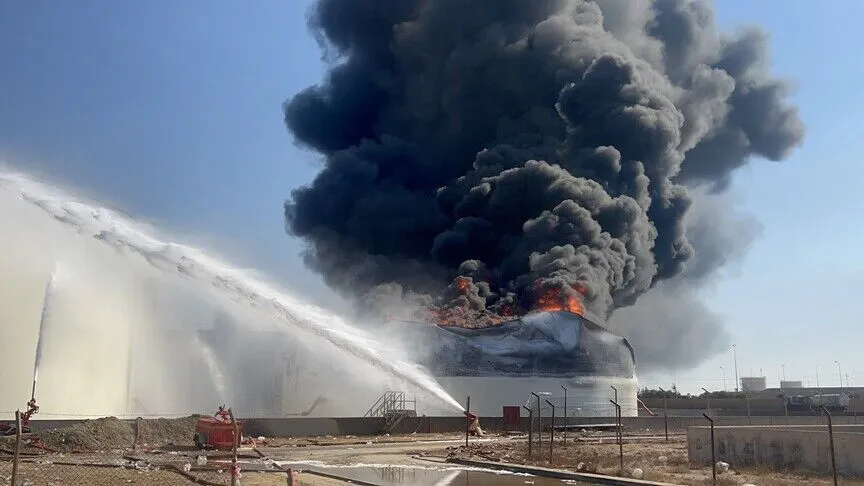
Zawiya’s Flames Expose Tripoli’s Failure to Protect Libya’s Oil
ZAWIA/TRIPOLI – After a hard-fought effort, firefighting teams, working with minimal resources, have brought under control a massive blaze that burned 4.5 million liters of gasoline at one of Libya’s largest oil refineries.
Suleman Masoud, chairman of the National Oil Corporation, urged local militias to keep their conflicts away from the oil sector. But the threat remains imminent. Drone attacks are ongoing, just hours ago, a drone exploded near a main gas pipeline at the Zawia Oil Refinery.
The Tripoli-based government has so far been unable to act against the handful of militias that have jeopardized the entire country. If it cannot even neutralize local gangs, while harboring some hardcore militants within its territory, how can it hope to defend Libya against an external threats ? And despite carving out large sums from the national budget in the name of defense and security, the Tripoli government is failing badly to rein in these local gangs and militias, who are exploiting state openly, leaving Libya’s resources unprotected.
Fifteen years after 2011, billions of US dollars have been embezzled from state funds. Under Abdul Hamed Dbeibeh, the longest-serving prime minister, in power for six years, the dollar has climbed from 1.30 LYD to 6.40 LYD in banks and 9.00 LYD on the black market. Unchecked corruption is dragging the state from welfare toward an underdeveloped, impoverished, and corrupt future.
Yet after squandering billions of dollars, not a single meaningful development has taken place in the capital or surrounding regions in any sector, beyond the most basic improvements. More alarming is that country is on the verge of financial collapse is being managed with such recklessness by the Tripoli-based government. Former Central Bank of Libya governor Sadeek Kabir stated that the country lacks sufficient reserves, while the prime minister insisted the opposite, claiming the state holds nearly 90 billion USD in reserve. Amid this chaos, a state weighed down by enormous subsidies, rampant corruption and embezzlement, and instability from ongoing conflicts could run deep enough deficits to force borrowing from foreign financial institutions at steep interest rates, eventually imposing permanent taxation on a tax-free nation, starting with foreigners and ending with Libyans themselves.
At this point, the Tripoli-based government, and Prime Minister Abdul Hamed Dbeibeh specifically, faces two options…..step down and hold urgent elections, or take a firm stance to stabilize the state. The latter seems unlikely, given his failure to do so over the past six years. And rather than meeting an end like Muammar Gaddafi, who died fighting a one-sided war and became the scapegoat for the turmoil unleashed by the power vacuum. Dbeibeh is more likely to flee, becoming the next scapegoat, this time for a foreign debt trap.