– Brega Petroleum Marketing Company said fuel supplies are being moved to service stations around the clock, releasing aerial footage of operations at Tripoli Port.
The company said shipments are being transferred from the port to depots and then to stations across Libya as efforts continue to maintain fuel supplies amid the country’s acute gasoline shortage.
Brega Petroleum Marketing Company has released details of fuel sales from the Sebha Oil Depot, showing continued distribution to service stations across Libya’s southern region.
According to the company’s figures for September 5, 2026, a total of 1.058 million liters of gasoline and 160,000 liters of diesel were allocated to 30 stations and distribution points.
The supplies covered areas including Sebha, Ubari, Ghadwa, Shati, Zawila, Bwanis, Tamanhint, Traghine and other locations across the south, with deliveries made through several distribution companies
LONDON — Libya’s Youth Minister under Tripoli based government Haitham Al-Zahhaf attended the closing events of the international Hult Prize entrepreneurship competition in London.
Al-Zahhaf met with the organization’s senior officials to discuss supporting Libyan youth, promoting innovation and expanding international opportunities for young entrepreneurs.
The visit was also attended by the Hult Prize’s Libya representative, ministry officials and embassy staff
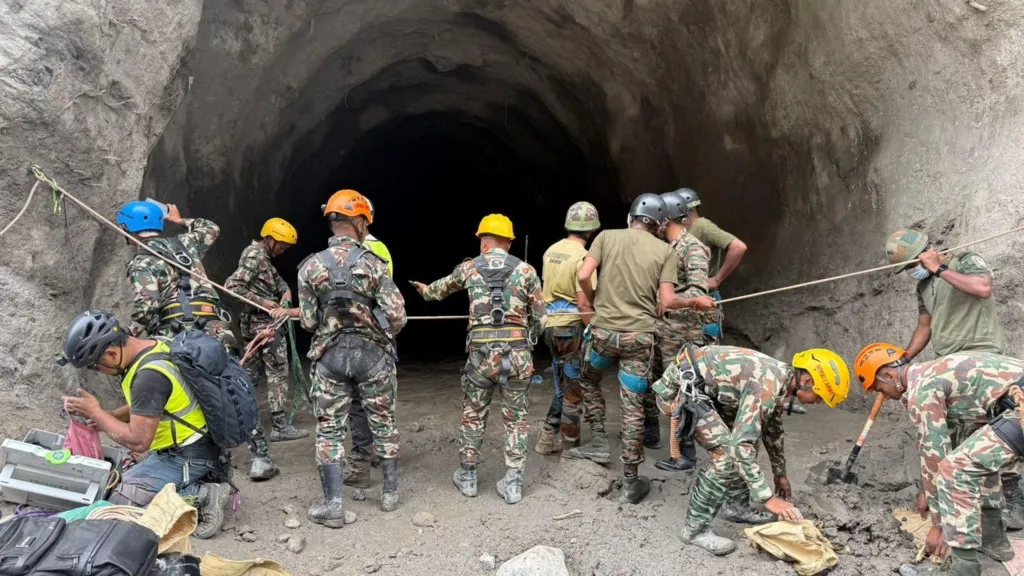
NEPAL – More than 600 workers are feared trapped in mud-filled hydropower tunnels along Nepal’s Trishuli River, and their families are holding onto hope they’ll be found alive. Rescuers are using explosives to blast into the hillside and pumping air into the tunnels, racing against a closing window for survivors.
The disaster on the Nepal-Tibet border has killed at least 939 people in Nepal, with the number missing revised to 3,925 , including 592 foreigners. Around one in seven of the missing are hydropower workers. Nepal’s prime minister said 279 people had been rescued from the plant sites and more than 11,000 overall.
The operation, led by Chinese and Nepalese troops with help from India, Korea and Australia, has been slowed by devastated terrain , one expert described house-sized boulders and a “lunar landscape” where the tunnels have vanished. Families say the air-pumping should have started sooner and are frustrated by the pace.
Downstream in Chitwan, nearly 300 bodies have washed up, forcing overwhelmed authorities into temporary burials while DNA is collected to identify remains. In Tibet, China reports 16 dead and 546 missing, amid heavy censorship , both China and Nepal have penalised or removed online content over flood “misinformation.”
The UN Support Mission in Libya (UNSMIL) welcomed the signing of an agreement reached through its “mini-meeting,” calling it an important step toward resolving Libya’s political deadlock and holding national elections.
The agreement covers the restructuring of the High National Elections Commission and amendments to the legal and constitutional framework for presidential and parliamentary elections. It calls for both elections to be held under a single executive authority within “no more than 24 months”.
The agreement also provides for its ratification by the Benghazi-based House of Representatives and Tripoli-based High Council of State within one month, along with a mechanism to monitor implementation.
UNSMIL chief Hanna Tetteh said the signing was a significant step but “not the end of the political process” , urging Libyan institutions and political actors to implement their commitments and prioritize elections.
The UN said it will continue supporting the process and efforts to unify Libya’s state institutions.
TRIPOLI – Prime Minister of Tripoli based government Abdul Hamid Dbeibeh welcomed the UN backed agreement made by the 4+4 Dialogue Committee, calling it an important step. He said it supports what he has long asked for: ending the temporary phases and moving toward elections.
Dbeibeh said the choice belongs to the Libyan people. Elections would end the division in the country and give its institutions real legitimacy. He hoped the agreement would keep elections as the top priority and help bring Libya toward stability and rebuilding.
BENGHAZI – Deputy Commander-in-Chief of the Libyan Arab Armed Forces, Lieutenant General Saddam Haftar, has welcomed the signing in Tripoli of a UNSMIL-facilitated agreement between Libya’s rival parties, calling it an important step toward long-delayed presidential and parliamentary elections.
The deal was signed on Sunday at UN Support Mission headquarters in Tripoli by the “4+4” committee , four representatives from eastern Libya and four from the west, drawn from the Government of National Unity, the High Council of State, the House of Representatives and the Libyan National Army. It restructures the board of the High National Elections Commission and resolves disputes over electoral laws that had stalled the process since the collapse of the December 2021 vote.
Under the agreement, presidential and legislative elections are to be held within a period not exceeding 24 months, under a single executive authority and unified national institutions.
Saddam Haftar reaffirmed his commitment to unifying the country and holding free and fair elections, commended the Commander-in-Chief for backing the effort, and said there was no longer any justification for delay. The next phase, he added, must focus on implementation and moving toward simultaneous elections for a unified, stable state.
TRIPOLI — Abdulhamid Dbeibah, prime minister of Libya’s Tripoli-based government, met Syrian Foreign Minister Asaad Hassan al-Shaibani in Tripoli on Sunday to discuss strengthening bilateral relations and reactivating cooperation between the two countries.
The talks covered diplomatic representation, economic and trade cooperation, security and counterterrorism, consular services, outstanding financial issues, and the possible reopening of the Syrian consulate in Benghazi.
TURKEY – Libya’s Chief of General Staff under Tripoli based government , Lt. Gen. Salah al-Din al-Namroush, met his Turkish military chief of staff in Ankara on August 30 to discuss expanding military cooperation. The talks focused on training, military expertise, army development and readiness, with particular attention to the Air Force and Special Forces. Turkey reaffirmed its support for strengthening the capabilities of the Libyan military and contributing to the development of a unified, professional army.
TRIPOLI – Libyan businessman Husni Bey estimates that every hour of electricity outages costs Libya’s economy over LYD 25 million in lost output and extra energy costs, warning that the power and fuel crises are driving inflation and eroding purchasing power.
In an interview with Ean Libya, Bey said rising prices can’t be blamed on traders alone, pointing to public spending, a weak dinar, money creation, energy shortages and high import costs. Outages hit twice , businesses lose production while households pay more for generators, which are costlier and less efficient than central gas plants.
He challenged the idea that electricity is free, estimating the true cost at about LYD 3,300 a month for a six-person household once state costs are counted. “There is no such thing as free electricity,” he said , only a bill paid by the consumer or hidden by the state in the budget. The same applies to subsidised fuel.
Bey urged treating electricity reform as anti-inflation policy, calling for tighter spending, subsidy reform, reliable gas-fired power, and better metering. He said Libya has real potential in manufacturing, food processing and logistics , but only with stable electricity and predictable policy, and backed shifting from commodity subsidies to direct cash support.
“When the electricity goes out, we pay three times,” he said , for the grid, for generators, and in lost production.