Author: admin

Misrata to Host First Al-Arar International Festival in August

MISRATA – Misrata is preparing to host the first edition of the Al-Arar International Festival, running 18 to 22 August 2026, with a motorsport program featuring rally races, desert cars, and motorcycles.

Organizing committees are carrying out intensive work across the city to finalize event sites and complete arrangements ahead of welcoming visitors, according to organizers.

Held under the slogan “where the sea meets the desert,” the festival aims to combine motorsport, culture, and tourism. The full program is still being finalized, with visitor registration set to open soon

Libya Needs Up to $40 Billion to Boost Oil Output, NOC Chief Says

TRIPOLI — Libya needs between $30 billion and $40 billion in investment to develop new oil and gas resources and raise crude production from around 1.4 million barrels per day to 2 million by 2030, according to National Oil Corporation Chairman Masoud Suleman. More than 60 discovered oil and gas fields remain undeveloped due to a lack of capital.

Major international companies, including Eni, TotalEnergies, Chevron and ConocoPhillips, are expanding their activities in Libya, but investment remains constrained by political instability, security concerns and funding shortages.

The NOC is considering new investment models that would require foreign companies to cover more of the upfront development costs.

Suleman also pointed to security risks, fuel smuggling and heavily subsidised domestic fuel prices as major challenges facing Libya’s oil sector and its wider economy.

Libya’s Central Bank Governor, UK Ambassador Discuss Reforms

TRIPOLI — The Governor of the Central Bank of Libya, Naji Issa, met on Tuesday, August 18, 2026, with British Ambassador to Libya Martin Reynolds to discuss Libya’s evolving economic and financial situation and the bank’s efforts to carry out financial and economic reforms with relevant stakeholders.

The meeting also explored potential cooperation in building the Central Bank’s capacity through partnerships with financial institutions in the United Kingdom.

Libya, Jordan Hold Joint ‘Al-Tarabot 2’ Military Exercise

A delegation from the Libyan Arab Armed Forces, led by Chief of the General Staff under the Benghazi-based government, Lieutenant General Khaled Haftar, attended the joint military exercise “Al-Tarabot 2” (Interconnection 2), carried out by units from the Libyan Arab Armed Forces and the Jordanian Armed Forces.

The delegation included the Director of Military Training for the Jordanian Armed Forces, Brigadier General Mohammed Bader Al-Miqdadi, along with several Libyan military officers.

The exercise is part of ongoing efforts to strengthen military cooperation, exchange expertise, and enhance readiness and efficiency, contributing to the development of both countries’ armed forces.

GNU Condemns Benghazi Bombing That Killed Maj. Gen. al-Mansouri

TRIPOLI — The Tripoli-based Government of National Unity condemned the terrorist bombing that targeted Major General Fawzi al-Mansouri in Benghazi.

The government called on the Attorney General and the relevant authorities to launch an immediate investigation to determine the circumstances of the bombing, identify those responsible, and hold to account all who stand behind it.

Dbeibah, Turkish FM Fidan Discuss Libya Unity and Cooperation in Tripoli

TRIPOLI — Prime Minister of the Tripoli-based government Abdulhamid Dbeibah met Turkish Foreign Minister Hakan Fidan in Tripoli on Tuesday for talks focused on regional developments, Libya’s political process and bilateral relations.

The two sides discussed efforts to unify Libya’s state institutions and strengthen stability, while also exploring ways to expand cooperation between Libya and Türkiye across several areas of mutual interest.

Zawiya’s Flames Expose Tripoli’s Failure to Protect Libya’s Oil

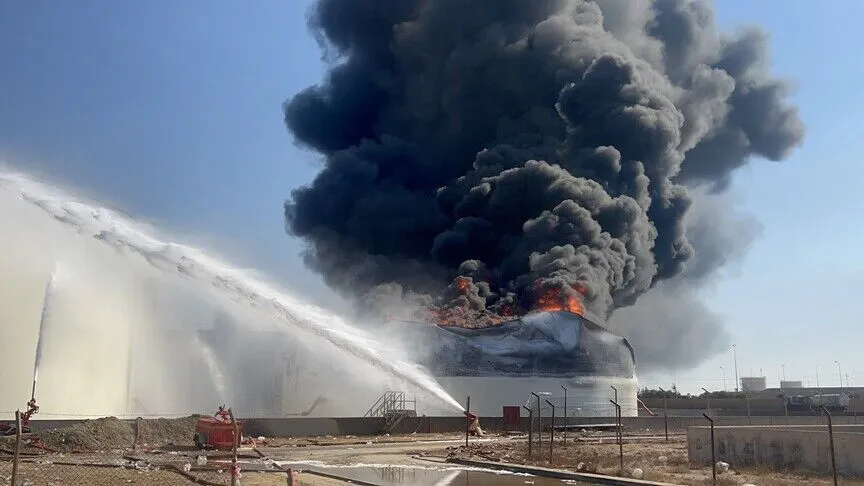
ZAWIA/TRIPOLI – After a hard-fought effort, firefighting teams, working with minimal resources, have brought under control a massive blaze that burned 4.5 million liters of gasoline at one of Libya’s largest oil refineries.

Suleman Masoud, chairman of the National Oil Corporation, urged local militias to keep their conflicts away from the oil sector. But the threat remains imminent. Drone attacks are ongoing, just hours ago, a drone exploded near a main gas pipeline at the Zawia Oil Refinery.

The Tripoli-based government has so far been unable to act against the handful of militias that have jeopardized the entire country. If it cannot even neutralize local gangs, while harboring some hardcore militants within its territory, how can it hope to defend Libya against an external threats ? And despite carving out large sums from the national budget in the name of defense and security, the Tripoli government is failing badly to rein in these local gangs and militias, who are exploiting state openly, leaving Libya’s resources unprotected.

Fifteen years after 2011, billions of US dollars have been embezzled from state funds. Under Abdul Hamed Dbeibeh, the longest-serving prime minister, in power for six years, the dollar has climbed from 1.30 LYD to 6.40 LYD in banks and 9.00 LYD on the black market. Unchecked corruption is dragging the state from welfare toward an underdeveloped, impoverished, and corrupt future.

Yet after squandering billions of dollars, not a single meaningful development has taken place in the capital or surrounding regions in any sector, beyond the most basic improvements. More alarming is that country is on the verge of financial collapse is being managed with such recklessness by the Tripoli-based government. Former Central Bank of Libya governor Sadeek Kabir stated that the country lacks sufficient reserves, while the prime minister insisted the opposite, claiming the state holds nearly 90 billion USD in reserve. Amid this chaos, a state weighed down by enormous subsidies, rampant corruption and embezzlement, and instability from ongoing conflicts could run deep enough deficits to force borrowing from foreign financial institutions at steep interest rates, eventually imposing permanent taxation on a tax-free nation, starting with foreigners and ending with Libyans themselves.

At this point, the Tripoli-based government, and Prime Minister Abdul Hamed Dbeibeh specifically, faces two options…..step down and hold urgent elections, or take a firm stance to stabilize the state. The latter seems unlikely, given his failure to do so over the past six years. And rather than meeting an end like Muammar Gaddafi, who died fighting a one-sided war and became the scapegoat for the turmoil unleashed by the power vacuum. Dbeibeh is more likely to flee, becoming the next scapegoat, this time for a foreign debt trap.

Militia Attack Destroys Zawiya Substation, Threatening Nationwide Blackouts

ZAWIA – A targeted attack by militias has destroyed a substation south of Zawiya, cutting power to large parts of the area, Libya’s state electricity company ( GECOL ) said. GECOL warned that if the attacks on infrastructure continue, the national grid could face partial or even total blackouts.

The unrest has also derailed major overhaul work at the Zawiya power plant, which has a capacity of 1,300 megawatts. Security concerns had already driven GECOL to pull its teams out last June, leaving more than 700 megawatts offline, and the latest attack has forced the company to down tools again. GECOL also reported new damage to 220 kV and 400 kV transmission lines, deepening the shortfall.

The company said it could not be held responsible for the resulting damage or power cuts, and called on all sides to protect the country’s power facilities and keep the technical crews working on them safe.

Field Marshal Mourns Slain Intelligence Chief as Terrorism Returns to Benghazi

BENGHAZI- Field Marshal Khalifa Haftar, Commander-in-Chief of the Libyan National Army, offered his condolences to the family of Lieutenant General Fawzi al-Mansouri, Director of Military Intelligence, joined by several senior commanders. He praised al-Mansouri’s service and sacrifices in the fight against terrorism, affirming that his legacy will guide future generations of officers.

The assassination, and the return of terrorism pushes Benghazi-based government into a tougher new set of challenges. The eastern region has been a victim of terrorism since 2011 and paid a heavy price to root it out.

Al-Mansouri was no ordinary loss. A close aide to the Field Marshal and a veteran of the war against militants that Haftar led and won, he played a key role in the Tripoli campaign against armed factions. As Sabha commander in the south, he tore out the roots of militants and smugglers in 2022. Then came the top intelligence post. A professional soldier with major victories and deep experience , killed at that level.

All this comes at a critical moment, especially with the unification process under way under US and international sponsorship. With the Benghazi-based government at the center of that axis, the assassination raises questions of trust. Time is short. Benghazi’s authorities must catch those responsible and bring them to justice , unlike Tripoli, where the killings of military chiefs, senior commanders, Saif al-Islam Gaddafi (son of former leader Muammar Gaddafi), and pro-government militia figure Abdulghani al-Kikli, known as Ghanewa, remain unresolved.

Haftar Meets Turkish FM Fidan in Benghazi as Ties Deepen

BENGHAZI — Field Marshal Khalifa Haftar, Commander-in-Chief of the Libyan National Army, met Turkish Foreign Minister Hakan Fidan and his accompanying delegation in Benghazi.

Following the meeting, Eng. Belgasim Haftar, Director General of the Libyan Development and Reconstruction Fund, held separate talks with Fidan focused on expanding bilateral cooperation and strengthening the role of Turkish companies in reconstruction and development projects across Libya.

Belgasim Haftar later accompanied the Turkish delegation to the tomb of Libyan resistance leader Omar al-Mukhtar before seeing them off at Benina International Airport.